Sunday, October 30, 2016

Consequences of the Nomonhan Incident

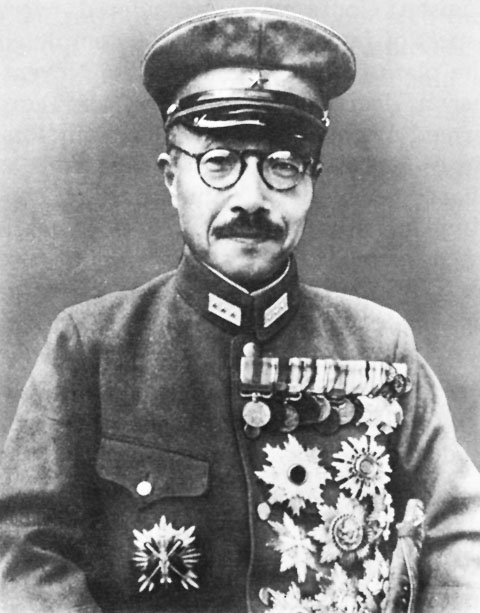
Hideki Tōjō, Japanese Prime Minister (1941-44)
and Minister of War (1940-44) (wikipedia).
The Nomonhan Incident ended on the 15th September 1939 as a result of a humiliating Japanese defeat against the Soviets. This loss raised a discussion in the core of the Japanese leading officers, about if they should keep pursuing their north expansion plans (Hokuhin-ron) or switch their focus to the south (Nanshin-ron) instead. 

The end of the Nomonhan incident coincided in time with the German invasion of Poland, which was followed by the German invasion of France a year later. During this time, the Nanshin-ron was the leading policy in Japan, still fighting China in the Second Sino-Japanese War. The lack of progress in China led to the Japanese invasion of the whole French Indochina in July 1941. This invasion, due to the weakness of the French, the British and the Dutch after the war in Europe, would help to cut off foreign aid supply to China and enable the creation of a Southern front.


Thursday, October 27, 2016

Type 41 75mm Regimental Gun

The Type 41 75mm mountain gun was accepted in 1908 (the 41st year of Emperor Meji's reign, which gives it its Type 41 name), originally a license-build copy of the German Krupp M.08 mountain gun. From 1934, when the new Type 94 75mm mountain gun was accepted, the Type 41 gun become an infantry regimental gun (Rentai Ho). Every infantry regiment was equipped with four Type 41 75mm guns, hence a triangular division as the IJA 23th Infantry Division had twelve guns.

Type 41 75mm mountain gun (commons.wikimedia.org).

Sunday, October 23, 2016

Hohei Regimental Gun Platoon!

The Hohei Regimental Gun Platoon consists on a command team, an observer team and two Type 41 75 mm gun. Used for infantry support, every regiment was equipped with four Type 41 guns, which adds up to twelve guns per division. Detailed info on how to assemble, paint and base Japanese guns can be found in older posts.


Regimental Gun Platoon Command team. 

Thursday, October 20, 2016

Type 94 37mm Rapid-fire Gun

The Type 94 Rapid fire gun was an anti-tank and infantry support gun designed in 1934 (2594 in the Japanese imperial year, from where it takes its type "94"). It was the main Japanese anti-tank gun until the development of the Type 1 47mm Anti-Tank gun in 1941. However the Type 94 gun remained active in all the fronts through the end of the war, as the new Type 1 could not be produced fast enough.


Japanese Type 94 37mm anti-tank Gun abandoned in Guadalcanal, 1942 (ww2db).

Monday, October 17, 2016

Hohei Type 94 37mm Rapid-fire Gun Platoon!

The Hohei Rapid-fire Gun Platoon is formed by a command team and two Type 94 37mm anti-tank Gun. This is the main anti-tank gun of the Imperial Japanese Army in Rising Sun. Every infantry regiment was equipped with a battery of four Type 94 guns, so a triangular division would field twelve guns. You can find detailed info on how to assemble, paint and base the guns in older posts.

Rapid-fire platoon command team. 

Saturday, October 15, 2016

Type 92 70mm Battalion Gun

The Type 92 Battalion Gun was a light howitzer introduced in 1932 (2592 in the Japanese imperial year, from where it takes its type "92"). Since every infantry battalion was equipped with two Type 92 guns, it was named Battalion Artillery (Daitaihō), and therefore a triangular division as the IJA 23th Division was equipped with eighteen Type 92 guns.

Type 92 70mm gun (www.historicalfireamrs.info)

Thursday, October 13, 2016

Hohei Type 92 70mm Battalion Gun Platoon!

The Hohei Battalion Gun Platoon consists of a command team, an observer team and two Type 92 70mm Gun. This gun was used as infantry support, as it could be used as a mortar or in direct fire. Every infantry battalion was equipped with two Type 92 guns, so a triangular division would field eighteen guns. You can find detailed info on how to assemble, paint and base the guns in older posts.


Command team.