Showing posts with label history. Show all posts

Sunday, August 27, 2017

The Siege of Baler

In June 1898 during the Philippine revolution, about 50 Spanish green conscripts under the command of Enrique de las Morenas were sent to the town of Baler, some 200km north-east of Manila.A "rebel" Katipunan group under command of Teodorico Novicio Luna was known to be operating on the area of Baler.

Portrait of Novicio Luna at the Museo de Baler.

Shortly after their arrival in town and fearing a rebel attack, las Morenas ordered its troops to garrison in the church. The rebel attack occurred just a few days later, starting a siege of the church that lasted for 337 days. 

Saturday, June 10, 2017

The Yasuoka Detachment of Masaomi Yasuoka

Masanobu Tsuji (wikipedia)
On June 1939 the Kwantung Army planed an offensive against the Soviets on Nomonhan. Following the plans of  Major Masanobu Tsuji, Kwantung Army commanding General Kenkichi Ueda approved the deployment of reinforcements on the Nomonhan area. As part of these reinforcements, the Yasuoka Detachment was created.

The Yasuoka Detachment, a powerful strike force under command of Lieutenant General Masaomi Yasuoka, consisted on:


Monday, May 22, 2017

4th Sensha Rentai of Colonel Yoshio Tamada

The history of the 4th Sensha Rentai (4th Tank Regiment) of the Japanese Imperial Army starts in 1934 in Manchukuo, with the creation of the 4th Tank Battalion. After the Marco Polo Bridge Incident in 1937, the Kwantung Army  upgraded the 4th Tank Battalion into the 4th Tank Regiment on August 1938. Its first commander was Colonel Yoshio Tamada.

Yoshio Tamada was born in September 23rd 1891 in Niigata Prefecture. He graduated from the military academy on 1913 and progressively ascended to First Liuetenant, Captain and finally Major in 1935. He was appointed as instructor on the Army Tank School in 1936 and was promoted to Colonel on July 1938,shortly before being appointed as commander of the 4th Tank Regiment.

Type 95 Ha-Go Light Tank (pinterest).

Saturday, May 20, 2017

3rd Sensha Rentai of Colonel Kiyotake Yoshimaru

The 3rd Sensha Rentai (3rd Tank Regiment) of the Japanese Imperial Army was created in August 1937 in Manchukuo, as an upgrade of the 3rd Tank Battalion after the Marco Polo Bridge incident.
Its first commander was Colonel Yamazaki Mikichi.

The regiment consisted on the regimental headquarters, the 1st tank company, 2nd tank company, 3rd tank company, 4th tank company and the repair and replacements company.

Type 97 Chi-Ha tanks (pinterest)

Wednesday, May 10, 2017

Type 97 Chi-Ha medium tank

The Type 97 Chi-Ha was a medium tank introduced in 1937 (imperial year 2597 from when it takes its designation) to improve and upgrade the performance of the already obsoleted medium tank Type 89 Chi-Ro. The old Type 89 had proved to be too slow to be effective on modern motorized warfare, and therefore the Type 97 was intended to improve both the Type 89 medium tank and the Type 95 Ha-Go light tank.

Type 97 Chi-Ha, date and location unknown (pinterest).

Saturday, May 6, 2017

Type 95 Ha-Go light tank

The Type 95 Ha-Go was a light tank accepted as the main japanese tank for mechanized infantry units in 1935 (2595 in the Japanese imperial year, from where it takes its type "95"), because their old Type 89 medium tank was too slow to keep the truck pace. It started to be produced in 1936 by Mitsubishi Heavy Industries.

Type 95 Ha-Go light tank early model (commons.wikimedia.org).

Thursday, November 17, 2016

The Mukden Incident

The Russo-Japanese War (1904-1905) ended with the Treaty of Portsmouth, which gave Japan control of the Kwantung Leased Territory and the South Manchuria Railway and forced the evacuation of Russian forces from Manchuria. The Kwantung Army was then created to protect the leased territory. In 1910, Korea was annexed into the Japanese Empire. 

Map of the invasion of Manchuria, 1931 (Pinterest).

Saturday, November 12, 2016

Puppet state of Manchukuo

The state of Manchukuo was established after the proclamation of independence of Manchuria from China on 18 February 1932, following the Japanese invasion of Manchuria. Said invasion was triggered by the Mukden Incident: Kwantung Army officers, without the approval of the Japanese government, plotted the detonation of a small bomb close to a Japanese owned railway line near Mukden. Chinese activists were blamed to have caused the explosion and in response the Kwantung Army invaded the Chinese Manchuria provinces.

Map of the invasion of Manchuria, 1931 (Pinterest).

Sunday, October 30, 2016

Consequences of the Nomonhan Incident

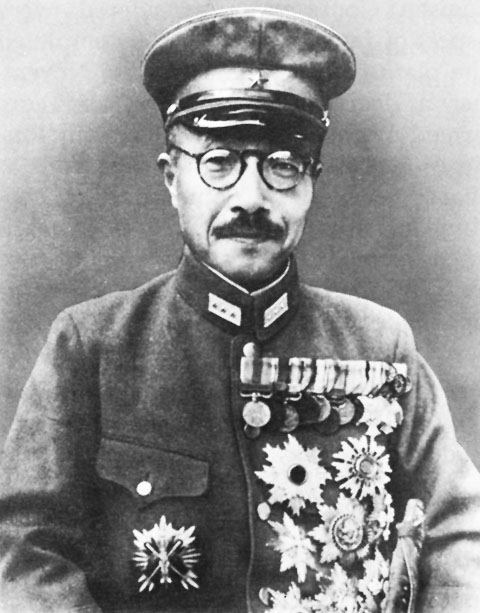
Hideki Tōjō, Japanese Prime Minister (1941-44)
and Minister of War (1940-44) (wikipedia).
The Nomonhan Incident ended on the 15th September 1939 as a result of a humiliating Japanese defeat against the Soviets. This loss raised a discussion in the core of the Japanese leading officers, about if they should keep pursuing their north expansion plans (Hokuhin-ron) or switch their focus to the south (Nanshin-ron) instead. 

The end of the Nomonhan incident coincided in time with the German invasion of Poland, which was followed by the German invasion of France a year later. During this time, the Nanshin-ron was the leading policy in Japan, still fighting China in the Second Sino-Japanese War. The lack of progress in China led to the Japanese invasion of the whole French Indochina in July 1941. This invasion, due to the weakness of the French, the British and the Dutch after the war in Europe, would help to cut off foreign aid supply to China and enable the creation of a Southern front.


Thursday, October 27, 2016

Type 41 75mm Regimental Gun

The Type 41 75mm mountain gun was accepted in 1908 (the 41st year of Emperor Meji's reign, which gives it its Type 41 name), originally a license-build copy of the German Krupp M.08 mountain gun. From 1934, when the new Type 94 75mm mountain gun was accepted, the Type 41 gun become an infantry regimental gun (Rentai Ho). Every infantry regiment was equipped with four Type 41 75mm guns, hence a triangular division as the IJA 23th Infantry Division had twelve guns.

Type 41 75mm mountain gun (commons.wikimedia.org).

Thursday, October 20, 2016

Type 94 37mm Rapid-fire Gun

The Type 94 Rapid fire gun was an anti-tank and infantry support gun designed in 1934 (2594 in the Japanese imperial year, from where it takes its type "94"). It was the main Japanese anti-tank gun until the development of the Type 1 47mm Anti-Tank gun in 1941. However the Type 94 gun remained active in all the fronts through the end of the war, as the new Type 1 could not be produced fast enough.


Japanese Type 94 37mm anti-tank Gun abandoned in Guadalcanal, 1942 (ww2db).

Saturday, October 15, 2016

Type 92 70mm Battalion Gun

The Type 92 Battalion Gun was a light howitzer introduced in 1932 (2592 in the Japanese imperial year, from where it takes its type "92"). Since every infantry battalion was equipped with two Type 92 guns, it was named Battalion Artillery (Daitaihō), and therefore a triangular division as the IJA 23th Division was equipped with eighteen Type 92 guns.

Type 92 70mm gun (www.historicalfireamrs.info)

Monday, October 10, 2016

IJA 7th Infantry Division

Jacob Meckel (Wikipedia)
In 1895, the Japanese government started a reorganization process of the Imperial Japanese Army with the purpose of modernizing it. The army was to be modeled after the Prussian army, due to the German victory against the French in the Franco-Prussian War. Prussian Major Jacob Meckel was invited to Japan as military adviser to oversee the rebuilding process.

The first infantry division created following Meckel´s advice was the 7th Infantry Division, nicknamed as Bear Division, formed in Sapporo, Hokkaidō on 12 May 1888. Its original duty was the defence of Hokkaidō, and was garrisoned in Asahikawa.

It was originally a square division, meaning that it was formed by four Infantry Regiments, and with two regiments forming a Brigade. It was not yet converted to a triangular division until 1942. At the beginning of the 20th century, the 7th division components were:

Saturday, October 1, 2016

Type 3 Heavy Machine Gun

The Type 3 Heavy Machine Gun (also known as the Taishō 14 Machine Gun) was the first Japanese machine gun to be domestically designed. It appeared in 1914, designed by General Kijiro Nambu, and was based on the french Hotchkiss M1914.


Type 3 Heavy Machine Gun (worldofweapons.blogspot.com).

Some differences with the Hotchkiss model were the feed, the fire controls and the locking system. It also modified the caliber, as the French one used 8mm cartridges and the Japanese used their then standard 6.5x50mm Arisaka ammunition.

Tuesday, September 27, 2016

General Kenkichi Ueda

Kenkichi Ueda (ww2db.com).
Kenkichi Ueda (植田 謙吉 in Japanese) was born on March 8th 1875 in the Osaka prefecture. In 1989 he graduated from the Imperial Japanese Army Academy (10th class) and in 1908 from the Army Staff College (21st class), serving in the cavalry in between. After graduating he was attached to the cavalry staff. In 1918 he was assigned to the Siberian Expeditionary Army which was part of the allied powers fighting against Bolshevik Red Army in the Russian Civil War. In July 1919 he was promoted to colonel.

Ueda was again promoted to major general in August 1923 and appointed commanding officer of the 3rd Cavalry Brigade. In March 1929 he became commander in chief of the Japanese China Garrison Army based in Tianjin, after having been promoted to lieutenant general in August 1928.  

Friday, September 23, 2016

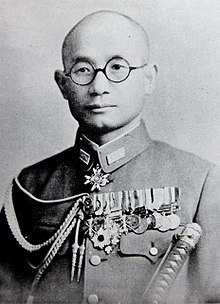
Lieutenant General Michitarō Komatsubara

Imperial Japanese Army Academy, Tokyo 1907
(wikipedia).
Michitarō Komatsubara (小松原 道太郎 in Japanese) was born on 20 July 1885 in Yokohama, Kanagawa Prefecture in Japan. He was the eldest son of naval engineer Goryo Komatusbara, and brother of Sakanoboro Komatsubara, who would become an Army Colonel.

In 1905 at age 20, Michitarō graduated at the Imperial Japanese Army Academy as member of its 18th class. In 1909-1910 he was assigned to Moscow as military attaché to Russia. There he gained knowledge and understanding of Russian culture and society as well as became fluent in Russian language.

Tuesday, September 20, 2016

IJA 23rd Infantry Division

Liutenant General Komatsubara.
After the start of the Second Sino-Japanese war in 1937, the Imperial Japanese Army (IJA) underwent an expansion process that included the formation of new infantry divisions 15th, 17th 21st, 22nd and 23rd on 4 April 1938 in Kumamoto, on the island of Kyushu.

23rd division, nicknamed as "Sunrise Division" and commanded by Lieutenant General Michitarō Komatsubara, was assigned to Kwantung Army and based in Hailar, Manchukuo, with the duty of controlling the border between Manchukuo and the Mongolian People´s Republic. 

It was a triangular division, meaning that its infantry was grouped in three regiments. At the time of its creation, it consisted on:

Friday, September 16, 2016

Kwantung Army

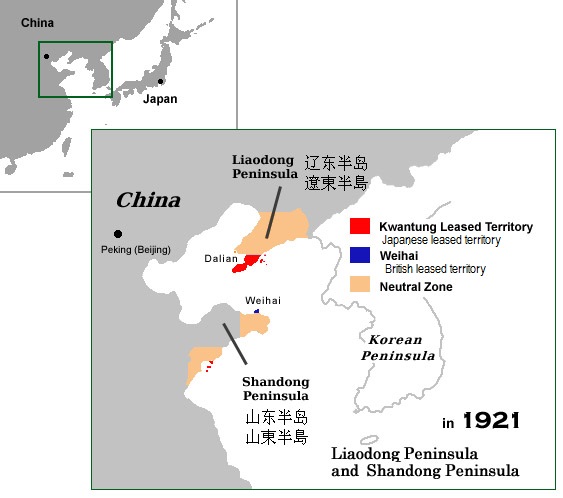
Map of the area in 1921 (Wikipedia).
After the Russo-Japanese war, in 1905, Japan replaced Russia as holder of the Kwantung Leased Territory. One year later, the Kwantung Garrison was created to defend the leased territory, and was renamed to Kwantung Army in 1919, when it had a total strength of 10.000 men.

Kwantung Army was an army group of the Imperial Japanese Army (IJA), and despite being under command of the Imperial General Headquarters, its officers were known for their insubordinate attitude referred as Gekokujō: "overthrowing or surpassing one's superior" or "rule from below".

Sunday, September 11, 2016

Nomonhan Incident (May - September 1939)

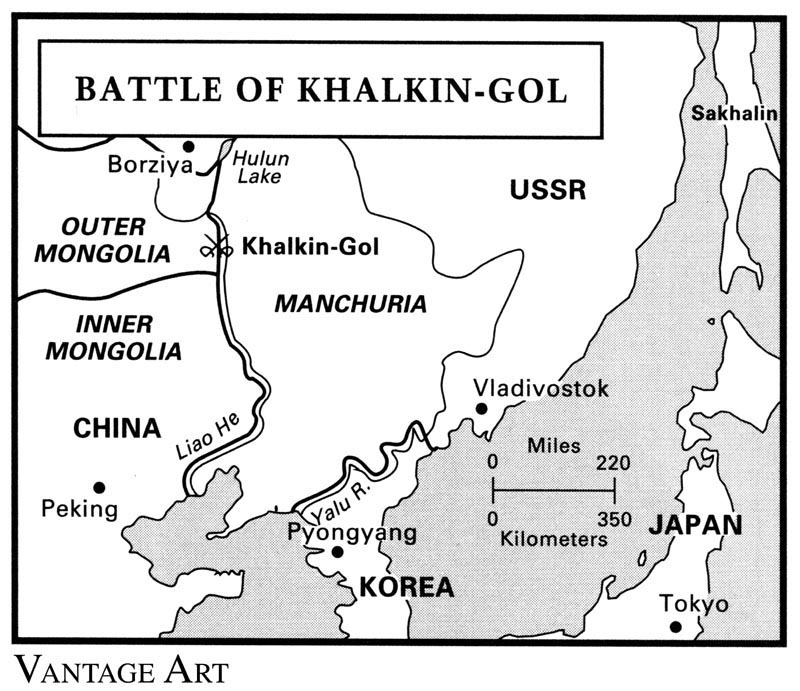
Manchuria Map, 1939
Japan occupied Manchuria in 1931 and established the puppet state of Manchukuo. To the west, Manchukuo's border was the Mongolian People's Republic, the only communist state in the world at that time other than the Soviet Union and a Soviet allied.

In 1939, there were disputes about the border line between Mongolia and Manchukuo, with the Japanese claiming the border to be the Khalkhyn river (Khalkhyn Gol) and the Soviets arguing it to be 16 km east of the river, by the town of Nomonhan. These disputes rapidly escalated to what came to be known as the Nomonhan Incident in Japan and the Battle of Khalkhyn Gol in Soviet Russia.

Japanese Forces at Nomonhan (Pinterest)
On May 11th 1939, about 70-80 Mongolian cavalry men entered the disputed area to feed their horses. Manchuoko´s cavalry attacked and expelled the Mongolians back to their land, but Mongolians counterattacked on May 13th with greater numbers and the Manchuoko's men were forced to retreat. The Japanese deployed the 23th Division led by Lieutenant General Michitarō Komatsubara (under command of the Kwantung Army) and drove the Mongolians out. On May 28th, Mongolian and Soviet forces returned to the disputed area and defeated the reconnaissance regiment of the 23th division, causing the first major defeat for the Japanese.

Monday, September 5, 2016

Rising Sun!

The first Flames of War book featuring the Japanese army was Rising Sun. The book belongs to the early war period (1939-1941), together with Blitzkrieg, Hellfire and Back, Burning Empires and Barbarossa.

Rising Sun cover page.

Rising Sun includes Japanese, Finnish and Soviet lists and focuses on the following battles:
  • Nomonhan incident (May - September 1939), a succession of battles between Japanese and Soviet troops at the border between Mongolia and Manchuria.